137 Madeira Excursion 28.7.2023
Jul 31, 2023 at 9:08 am | Posted in Posts | Leave a commentTags: cancela, civil protection, Madeira, protecao civil, safety, srpc
We visited the Civil Protection Centre in Cancela (SRPC) (https://www.procivmadeira.pt/pt/)
The presentations
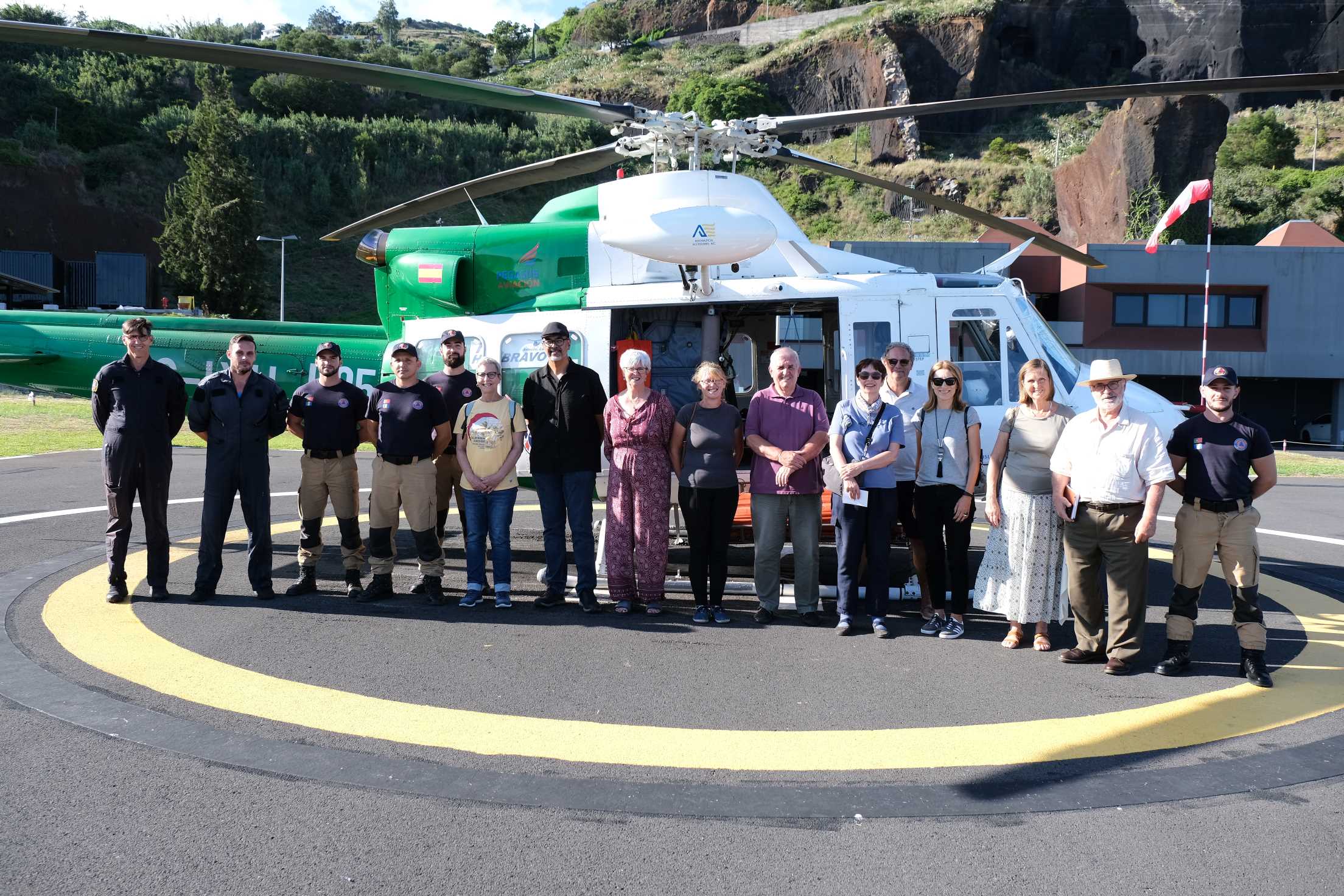
Dr. Quintino gave us a basic presentation, and his colleague André showed us the functionalities in the Crisis Centre Room. Then the pilots and crew presented themselves next to the helicopter for us (we don’t need Tom Cruise here…)
The top points:
The SRPC mission is to prevent the risks inherent in situations of serious accident or catastrophe, as well as resolve the effects resulting from such situations, helping people and protecting property. The SRPC also guides, coordinates and supervises the activities carried out by the fire departments, as well as all civil protection and rescue activities. Information to the public (kids and adults) is also a big part of their duty.
During a flooding for example, they are in charge of the coordination of all services involved, including Police, Red Cross, Forest Police, Sanas (water rescue), and all institutions on land. The Navy, Army and Airforce have a separate operation. However, they work closely together ensuring that during an emergency the chain of command is effective and coordinated.
The island has a special situation due to the old days, when there was no Via Rapida. Several locations have their own firefighters /bombeiros / sapateiros, (there are three levels the Sapadores (highest), regular firemen and the volunteers. It is still necessary to maintain three forces due to the topography and difficulty of the island terrain. They work all under the management of SRPC.
The App
The ProCiv Madeira App can be downloaded from the Google Play Store or Apple App. It provides information on the weather situation and real time information during catastrophes.
The App is being promoted at the airport and the port to tourists. However, as André pointed out, it is not tourists who are the greatest problem for them, the locals are more reckless during excursions as they treat the terrain with over-familiarity and confidence. The App also has a location device allowing for ground team to locate your position or as close as and will work whether there is a signal or not. Therefore, ideal for those walking along the levadas or in the mountains.
The App also has all your information including health problems such as diabetes, allowing for EMIR and the emergency services to know beforehand of any pre-existing health issues.
A further idea was mooted, and that was for charging to use the levadas and having a controlled entry system, ensuring that the levadas are not overused, can be monitored and the money used to carry out running repairs and create barriers. Although some tourists completely disregard them, even if there is a 300 m drop the other side. A photo of a lifetime may be the last photo they ever take…
Forest fires
Forest patrol is done by the respective police, and the helicopter is available from June to November. The forest police are responsible for any fire above 900m above sea level. We had the last big fire in 2016.
Fire prevention in the city
Private homeowners know what to do in order to prevent a fire in and around their house – they are information sheets and articles around – but the Portuguese mentality does not lend itself to prevention actually being done.
Forest fire prevention measures
The forests cannot be cleaned (e.g. with mincing machinery) to prevent new fires as on the mainland because of the geography of the island. Old debris piles up, this cannot be avoided. Controlled fires also cannot be applied well on a mountainous island. Fires cannot be prevented but they will be controlled and extinguished in an effective manner.
Wild Camping
Wild camping is not a problem for the firefighters because in the old forests, the humidity is high, and it is less likely that a tourist can create a wildfire there. The Laurissilva does not burn.
Arson
Arsonists set fires; some of them are even known to the police and population. Proof is very difficult to come by. Many have mental health issues and judges tend toward leniency and let them off with a slap on the wrist. This is frustrating for the Civil Protection and other authorities as catching them in the act, in order to obtain proof is problematical.
Fire towers
The old fire towers have been reactivated and are staffed by the Forest Police, but it is difficult to find people to sit in a tower all day and watch for smoke. An island-wide camera system has been established; it is still in beta phase, but once fully functional, it will detect smoke much more reliably. Currently, the sensors are too sensitive and raise an alarm with every passing car that drives down the mountain – heat from the brakes. However, once the initial bugs are identified and fixed, this will be an invaluable detection aid.
Controlled burning
If farmers have land rubbish, which has to be removed during summer (when lighting a fire is strictly forbidden), the fire brigades will accompany this and make sure nothing goes wrong. Farmers often underestimate the” small” fires they light themselves, they may not be aware that such a fire is still burring underneath when they leave.
The type of trees is also important for fire hazards. The islands endemic species have a low fuel yield and do not burn easily, but can be damaged by pests. Eucalyptus and Mimosa are not endemic, and burn easily, they also spread their seed with the help of fire. Eucalyptus is a “good” tree for wood paper making, but bad for the island’s environment. These species also displace endemic plants, suck up the water around them, creating a barren leaf litter which burns easily.
Landslides, falling trees
These events are unavoidable on this island, we will have to live with the risks. After the Monte tree tragedy, local councils cut down any tree they thought could cause a problem.
Control 24/7
The SRPC has a survey system for hot spots, combined with meteorological data so that they can evaluate the risk conditions in any part of the island at any time. They can see at any time where every fire truck, ambulance and other service cars are so that the response time can be optimised by the SRPC team.
All emergencies are categorised into three different levels. From P3, least important to P1, emergency, and in times when the emergency services are stretched to full capacity the system ensures that those who need help urgently, get it.
The Civil Protection are not impressed with hoax calls as they must treat every call as an emergency. They are not there to give information on the weather, road traffic conditions or report your neighbour for having a BBQ, unless the BBQ is out of control.
When contacting 112 in an emergency your first point of contact will be a PSP (Public Security Police) officer, who will ascertain the situation, and then, if it is not a police matter, forward your call to the Civil Protection. Do not hang up until you are told to do so as sometimes the person you are speaking to is taking notes, checking for information and locating the nearest emergency service team. They need to talk to you, so stay on the line.
They will also speak to you slowly. This is not because they are bored with your call. They have been trained to speak slowly and clearly so that it calms you down and allows you time to think, describe what is happening clearly and your location if you are not on a known road or area. Even a large tree, or an outcrop of rocks if you are in the countryside can give them pointers to your location. Obviously, it is easier in an urban location.
Construction after 2010
The riverbeds were clad out with lots of cement – this was successful. Most of the old riverbeds had to be cemented but not only to avoid loss of water. The rivers’ flow rate was improved so that the water is never too slow to drop sediments on the way. After a storm such as “Oscar” in June, a lot of cleaning has to take place in the rivers so remove boulders, trees and other debris, then the water reposited by such a storm as “Oscar” (more than in 2010) is not a problem for the rivers. So, it seems the money (also from the EU) was well spent. André said that rivers do not need to be pretty, they need to be functional.
Global Warming
The island will get hotter and wetter, and sea levels will rise. The Civil Engineers have to plan accordingly so that the sea water does not back up in the rivers during a storm.
Water supply
We have no waters shortages as yet, but we have more residents and tourists. Many municipalities still have to replace old water pipes to prevent water loss (Rua Bom Jesus: done; Rua Joao de Deus: being done now). Sta. Cruz still has 70% water loss in its pipes. The information to the Public should be better, as the recent destruction of city trees has caused outrage. However, these trees have destroyed the water network, so it was decided that when the pipes were replaced to remove the old ones and plant different trees whose roots are not so vigorous or water hungry.
EMIR Ambulances
We also saw the 4 EMIR rapid response vehicles, which come with a nurse and a doctor, they carry half a hospital in the back. One car is equipped for higher zones, three are used in the cities.
The helicopter
The Chopper has a crew of 8, which includes divers and additional firefighters if needed. They don’t use salt water; they scoop sweet water from eight sweet water lakes (a plane could not do that).
When the helicopter arrives at a fire, it will always circle the spot once or twice and send live images to the dispatch in Cancela so that they can assess what is needed on the ground to fight the fire. (They also have a some very useful drones for the evaluation, with heat indicators and zoom functions.) Then the chopper will set down a team of firefighters. The water (capacity 1200l in the bag, they usually load 1000 l) is not specifically used to extinguish the fire, it is used to douse the spot to lower the heat so that the team down there can work in safety.
The new hospital will have a landing site for the Chopper. At the moment they have to land at the airport and then the victim is transport by ambulance to hospital, which in the case of an emergency is inefficient and time consuming.
The helicopter is also used for search and rescue missions -day time only and has proved to be successful. Only last week two Czech tourists became lost and were airlifted to safety. On another occasion the helicopter crew managed to save a couple of lost tourists, as from the air they were able to identify their location, allowing the rescue teams to find them before darkness.
The helicopter can be changed from firefighting to rescue mode and vice versa in ten minutes.
Both helicopter pilots are highly trained and skilled as Madeira’s topography makes flying difficult, and not only due to fires, but down and up drafts can make flying hazardous.
Although the helicopter and crew have a two-hour flight time, most missions are contained within a one-and-a-half-hour period.
Charging for rescue operations?
Often, an accident sends a rescue large team into danger to rescue a person who has put himself in danger on a Levada. Could/should the state charge for the rescue? There we would have to draw a line after which we can charge at least part of the rescue cost to the person. But André thinks that it is not easy to distinguish what is only “stupid” or really reckless. This could be a topic for further discussion.

Many thanks to the SRPC Team!
135 Madeira Consorcio Excursion 18.5.2023
May 21, 2023 at 11:11 am | Posted in Posts | Leave a commentTags: Consorcio, este recycling, Madeira, rubbish, triage

We met with a small group in Porto Novo at the Recycling and Triage station Estação de Transferência da Zona Leste e de Triagem da Madeira (ETZL/ET) (https://arm.pt/residuos/tratamento/) ,
The recycling service on the island (including P Santo) consists of three plants: recycling/triage in Este: Meia Legua/Ribeira Brava , Leste Porto Novo, and the burning plant in Meira Serra.
We toured the facilities with ARM (state owned) colaborators Gorete and Ana Vera, a very interesting experience!
All rubbish is taken there: plastic/ packaging, glass, paper /card boxes and undifferentiated rubbish (which is compacted before being taken to Meia Serra for burning). The station also collects green cuts which go to Meia Serra for composting, and old chairs and metal scrap.
Mattresses are collected (burnt in Meia Serra), and furniture, the “monsters, go to the mainland, as well as car tires.
The facility has serval rubbish piles and spits out neat packages of aluminium cans (can be 100% recycled), cans, non-corrosive metal, paper, carton, glass and then PET bottles and household cleaning bottles.
The facility has a huge machine which is able to do the separation with optical means, magnets and such. In the end, a manual check for recyclable material finishes the circuit.
The recycling quality seems to be good. Around ten containers are shipped to the mainland per month and sold to recycling companies. They pay for the material; this goes helps offset the costs of the service. The mainland recipients do not refuse the material from Madeira, which means that the rubbish delivered is, so to speak, of high quality.
The “Este” station in Porto Novo has about 80 workers. The staff gets a bit more than minimum salary, and most of them live near Porto Novo.
125 Madeira Consorcio Meeting 19.3.2022
Mar 20, 2022 at 5:20 pm | Posted in Posts | Leave a commentTags: art, Cecilia Zino, children, foster, Funchal, fundacao, Madeira, projects, ukraine, war
João Mota, one of the administrators of the Foundation Cecilia Zino, gave us a presentation of the Foundation’s history and work.
The website is https://fundacaozino.com/, with an English version.
Cecilia Rose Zino created the foundation in 1961, and used an old hotel building owned by the family, to install a children’s hospital in 1961. (The Nélio Mendonca Hospital only opened in 1973.) The hospital played an important role in the last Polio outbreak in 1972 on the island.
After the opening of the N.M. Hospital, the Zino hospital was turned into a residential facility for children from poor families on the island. The Foundation used funds from the stock market to finance the work on a private basis.
The Foundation had plenty of staff; at times, the Home harboured more than 40 children. The service also relied on four Dominican Nuns which supervised the work very efficiently, from 1963 until their retirement in 2020. When a Nun leaves the service, three people have to be hired to replace her because the nuns worked 24/7.
The children who arrive at the Foundation are taken out of the families for various reasons, and given into the care of the Foundation. At this time, the Foundation as 15 children, from the age of 3 to 18. Even if a youngster turns 18, he/she will be assisted in various ways until the age of 26 years. (In Germany, children who turn 18, are on their own.)
The Foundation receives interest from the stock market; it also has rental properties which bring in additional money to cover the costs. In 2018, the costs were at around 600.000€/year. Now, with less children and staff, the cost has been lowered to a manageable amount. Still, the Foundation will be asking for Government support, also in view of the fact that the State intends to send more “problem” cases to the Foundation. They know that the Foundation has excellent staff with good training and a 1:1 ratio between staff and children. (There are six institutions on the island for the support of foster children and orphans.)
We have to keep in mind that these children need a lot of care; the families they come from, have serious problems with alcohol, drugs, violence and sexual exploitation.
The Foundation has new projects:
A new building for the now smaller group of children is to be built in Funchal.
A program to not only help needy children but also to assist their often-troubled families.
Scholarships for youngsters who are going to university and into professional training, until the age of 26.
Culture trips for the Children to visit museums in Lisbon and Porto.
Art Exhibitions: The Foundations offers a space in Rua do Bettencourt for young artists who are looking for promotors, they have interesting exhibitions, the topics always have to do with children and their world.
The Cultural Passport: The Foundation also started a project with the cultural passport, to incentivize children to visit museums and art galleries on the island. (The public museums are already covered by the schools.) The children get a stamp or two for a visit to an art gallery etc. In a lottery, they can then win a trip to Madrid or another city, or win iPads and other electronic devices. The Restock Gallery will be included in this project.
The vegetable plots in the Garden have been replanted, the children simply do not have much time to learn and do gardening work. They have to be taken to the public schools early, return often around 17, then they may have a meeting with a psychologist or speech therapy etc. and on the weekends, they often visit their families.
In the current war situation, the Foundation offered 5-6 beds to the Government for children from the Ukraine but the offer (as was in the case of the Syrian refugees) was not taken up by the state, citing bureaucratic problems.
Our thanks go to MZ and João Mota for the presentation!
124 Madeira Consorcio Meeting 12.2.2022
Feb 13, 2022 at 11:59 am | Posted in Posts | Leave a commentTags: Consorcio, lendwithcare, Madeira, microfinance, toilet twinning
Hello Team,
Based on an idea from H., we watched a short animation on www.lendwithcare.org
and a video clip on Youtube:
(Another one here about supporting women in Bosnia:
https://www.youtube.com/watch?v=vTaWMOqLfGQ )
Lendwithcare is a part of Care International, which after 1945, organized the CARE parcels sent from all over the world (also from Madeira Island) to the German population. Lendwithcare is asking for donations to keep the organisation going, but this is not a prerequisite to help an entrepreneur.
LendwithCare works in Zambia, Malawi, Rwanda, Georgia, Peru, Ecuador, Vietnam, Cambodia, Pakistan, the Philippines and the Occupied Territories of Palestine.
This is lending without interest and it is not a handout, from person to person, with the help of a local, carefully selected supervisory agency. CARE has a Conduct of Microfinance agreement for these agencies and does Due Diligence on them.
M.J. was nonconcerted that the money given is not costing anything and if something is free, that the entrepreneurs would not pay it back or even feel that they ought to pay it back. But it seems that as the lending is local, there is peer pressure in a population to pay back, in order to keep a good name with the neighbours. The whole system is based on trust.
M.J. said that the Governments should do the job and support their people but many Governments don’t do this. Cl. said that investigative journalism is essential, to keep the Governments in line and that there are organisations which support this kind of journalism (https://fij.org/ and https://www.investigativejournalismforeu.net/)
Poor people would not get a bank loan, NGOs do it instead. Grameen Bank started loans a long time ago (https://grameenbank.org/, the founder received a Nobel Peace Prize.
Lendwithcare works with local agencies which are selecting the entrepreneurs and are strict on the payback in time. The entrepreneurs are aware that the money would dry up if the funds were not paid back.
The person giving the money receives regular feedback on the payback situation, When the money is repaid the/she can reclaim it from Lendwithcare or keep it in the system to support other recipients. The system is transparent for all. The numbers show that the risk for the “donors” is low.
Another idea is “Toilet-Twinning”: https://www.toilettwinning.org/ A donor can give 60 GBP and facilitate a decent toilet for a family in a Third World country.
The website says:
| Without proper toilets and clean water, people are trapped in a vicious cycle: They’re likely to become sick through sanitation-related diseases Illness means they cannot work or farm their land, so they earn less or grow less food Children often miss school, because they are sick or because they’re busy collecting water Girls often drop out of school altogether when they start their periods if there are no toilets or changing rooms Parents have to pay for medicines or food, so they may fall into debt Women and girls risk being attacked or bitten by snakes as they go to the toilet in the open, especially if the culture dictates that they have to go out at night Water and sanitation projects enable families to build a toilet, have access to clean water, and to learn about handwashing and other hygiene principles. Dignity is restored when the whole family can use a private, hygienic toilet at their home and no longer have to squat in the bush. |
The website also explains how toilets are designed and built. But yes, they are holes in the ground within a cabin… better than nothing!
122 Madeira Consorcio Meeting 23.10.2021
Oct 24, 2021 at 3:12 pm | Posted in Posts | Leave a commentTags: climate change, Consorcio, Madeira, nature, Portugal
We met in the Gallery as usual and watched this talk:
The Talk is about the fact that we define Nature too narrowly as a system that hasn’t been touched by humans. Nature can include reforested and replanted areas; new ecosystems develop in such areas as well. Weed is not necessarily bad.
C. said that Cistercian and Franciscan monks in the middle age, who farmed large spaces of land for the church, were instructed to leave a third of the land “wild”
In Germany, the farmers are instructed to leave the side-lines of their fields untamed so that wild plants can grow there and provide at least a small space for insects and other wildlife to settle there.
Rewilding:
Here is a link with more information:
In Portugal, a space on Vale do Côa is supposed to be re-wilded
https://rewilding-portugal.com/pt/oeste-iberico/
It makes no sense to cut trees into shapes, just because we find it better. Trees should grow unhindered in the shape they need to be in.
Apple trees should be used to grow apples for juice, if they cannot be eaten. This potential should not go to wasted even if the product is a bit more expensive.
The other issue the speaker has is that children like to have wild nature to touch it and be in it. They have a right to find such spaces, not to be confined to State parks where they cannot interact with nature because it has to be protected. If humans interact with nature, they do so as a part of nature.
The Plumbago at the entrance of the Gallery is such a “wild space”.
There used to be many partridges on the island as well as rabbits and ferrets. They used to be hunted. Now, rabbits were re-introduced in the forest, only in order to be fodder for hunting…
Invasive species can be bad (the eucalyptus seeds are bad, and the trees grab too much water) but they also may very well turn out to become a blessing later (medicinal plants, protection for trees against specific insect threats etc).
Climate Change:
The 2021 COP – United Nations Climate Change Conference – will take place on Oct 31 in Glasgow. Avaaz will certainly ask for signatures or donations to pressure World Leaders to do something useful about the problem (I will forward the Avaaz message to you when it comes around, Ursula)
Russia and China didn’t get the message yet but more and more industry leaders are talking about strategies that respect nature and include it in their development of new products.
It will come down that we’ll have to curtail our personal footprint as much as possible. Medium distance flights within a country, for example, will have to be forbidden.
Other stuff:
Portugal got some refugees from Afghanistan, the female musicians from Zohra orchestra. There is a link to one of their concerts:
104th Madeira Consorcio Meeting 16.1.2019
Feb 17, 2019 at 12:35 pm | Posted in Posts | Leave a commentTags: Consorcio, elections, fact checking, Funchal, gallery, julian treasure, leon berg, Madeira, restock, trump
We met in a new venue the RESTOCK workshop room in Armazém do Mercado and I think it went very well!
The owners did a great job in providing and managing the technology and we enjoyed the videos and then ensuing discussion.
The videos were:
- A Talk by Leon Berg about the art of listening with the “Council” way:
https://www.youtube.com/watch?v=6iDMuB6NjNA
- Julian Treasure: 5 way to listen better:
https://www.ted.com/talks/julian_treasure_5_ways_to_listen_better
The art of listening is under threat by the influx of media information we are receiving. C. said that we need to deliberately speak to persons who are not of our opinion, and try to understand them.
This, almost automatically, lead to Donald Trump, who does not display great talent in this area.
Cl. volunteered to portray Trump, and he did a great job in arguing from this standpoint, we had a lot of fun with that!! Trump’s arguments for a wall to Mexico and a trade war were the main points.
There was the argument that the success Trump and other such political personalities have, is based on fear-mongering. Drugs are not coming across the US Mexican border, they are coming in planes and trucks, and M. knows somebody “inside” who told him that even the CIA is involved in the flourishing drug trade to the US today, as they were back in Vietnam and Laos. There is a movie about the events back then: https://en.wikipedia.org/wiki/Air_America_(film)
So a wall wouldn’t help to solve this problem.
The trade war: our “Trump” argued that as China has grown disproportionally, the old trade deals are unfair and must be revoked.
The argument went that Trump is just a façade for the people who are really in charge (Have a look at Noam Chomsky: “Donald Trump is a Distraction” on YouTube: https://youtu.be/uQvig0KvUaE)
D. said that 1% of the world population, the rich, are really managing the USA. Democracy is not supposed to work like this.
G said that the people who are really in power, manipulate the legislation to be in their favour and they will not be voted or kicked out of office like Trump. They will remain in power, and we have no way of identifying them and des-empowering them.
Do. said that Trump is a perfect actor for this kind if disguise, and that he will be even more powerful once he is out of office, he will remain a big “influencer” for years to come.
We also spoke about the fact that less and less people are voting. Cl. – as Himself – pointed out that most of the first-time voters in the 2016 election in the US voted for Trump so he managed to get out the vote. (Voting in the US takes place on a Tuesday, instead of on the weekend.)
Fact checking websites can be found here:
https://researchguides.library.syr.edu/c.php?g=258130&p=1725901
If any team member comes across an info, listing the Portuguese party programmes and affiliations for the European elections in May, please let U.know, this can be distributed to the whole group so that we know what we are voting for.
Other info:u!
One upcoming topic might be a discussion about the speed in which we are being fed news, and if we shouldn’t deliberately slow down our intake.
101st Madeira Consorcio Meeting 15.9. 2018
Sep 16, 2018 at 11:04 am | Posted in Posts | Leave a commentTags: amory lovins, calligraphy, casa, chris bliss, Funchal, Madeira, rocky mountain institute
D. presented a TED Talk by the co-founder of the Rocky Mountain Institute:
| “Amory Lovins was worried (and writing) about energy long before global warming was making the front — or even back — page of newspapers. Since studying at Harvard and Oxford in the 1960s, he’s written dozens of books, and initiated ambitious projects — cofounding the influential, environment-focused Rocky Mountain Institute; prototyping the ultra-efficient Hypercar – to focus the world’s attention on alternative approaches to energy and transportation.” |
This Institute stands for a positive approach, pointing to initiatives already underway by private enterprise and driven by the markets, to wean humanity off coal and oil by 2050. This will happen, whether the American President likes it or not.
The link:
https://www.ted.com/talks/amory_lovins_a_50_year_plan_for_energy#t-2560
U. mentioned a TED talk by a Comedian who said that cartoons are a great way of communication serious issues in a humorous manner. Cartoons may, for example, open up the mind of non-believers of global warming, so that they can be receptive to the fact that global warming really exists.
The link:
https://www.ted.com/talks/chris_bliss_comedy_is_translation
Other points:
| Japanese calligraphy class for beginners
Saturday 15th of September, 11h30 – 13h Thursday 20th of September, 12h30 – 14h RESTOCK Gallery in Armazem do Mercado
|
The Buddhist Centre is now having Cinema on each first Friday of the month:
| O CBM vai dar início a um ciclo de cinema chamado ‘Ver, Refletir e Discutir’.
É uma ocasião para ver filmes e documentários alternativos. Haverá também ocasião para um chá e bolachas. Local: Sede do CBM, Rua das Mercês 26 no 2º andar. Hora: 19h Entrada: 2 Budas Para as primeiras três sessões está programado o seguinte: 28 de Setembro: “Kundun” de Martin Scorsese. Duração 2h 10min 5 de Outubro: “Human Vol.I” de Yann Arthus-Bertrand. Duração 1h 24min 2 de Novembro: “O pequeno Buda” de Bernardo Bertolucci. Duração 2h 20min Pretendemos fazer uma projecção todas as primeiras sextas de cada mês, o dia 28 de Setembro é uma excepção. São todos muito bem-vindos! |
C.A.S.A. (https://casa-apoioaosemabrigo.org/index.php/delegacoes/casa-madeira) is looking for (permanent) volunteers for the evening food handout (every 14 days, they need people for Mondays and Fridays), the contact is Silvia, 91 0365816, madeira@casa-apoioaosemabrigo.org . You can also ask U., she is on a Monday team.
99 Madeira Consorcio Meeting 16.62018
Jun 17, 2018 at 11:02 am | Posted in Posts | Leave a commentTags: Carhart-Harris, Consorcio, ibuprofen, imperial college, Madeira, michael, paracetamol, pollan, psychedelics, wastewater
We met in U’s place to view a video by Dr. Carhart-Harris about research done in the UK and the United States about psychedelics; the link:
The patients undergoing these controlled studies were all severely depressed or had other mental afflictions. Although some of them underwent also bad trips during the study, the aftereffect on this group of patients was /is mainly very positive. One or two treatments can actually improve depression etc. for months at a time.
Michael Pollan wrote a book about the findings with a lengthy title: “How to change your mind – What the new science of Psychedelics teaches us about Consciousness, Dying, Addiction, Depression and Transcendence”. E and G have it,is also available as audio book.
An interview with Michael Pollan about his book is here:
Dr. Carhart-Harris’ mention in the Imperial College of London:
https://www.imperial.ac.uk/people/r.carhart-harris
It is actually possible to have psychedelics prescribed by a doctor (with a special procedure) for depression and other serious mental afflictions.
MAPS is a worldwide organizations that helps sufferers find a doctor who can prescribe psychedelics for their treatment
D mentioned that psychedelics help to un-focus – a behaviour that has been instilled in us from childhood – and to see the whole picture. Psychedelics do not cause hallucinations per se, they open the door to perceive them.
G said that the medical- industrial complex is suppressing the use of psychedelics even if they are beneficial to patients, because this would mean that they can sell less of their products.
It was discussed that these substances are not drugs, they are plant derivatives and natural, they dock in the body to receptors which also accept substances the body produces itself.
There seems to be a new understanding in the US that when people are depressed and kill themselves, the problem lies not with them but with the lifestyle. An interesting article by Kirsten powers is here:
U mntioned that wastewater – which is recycled in cities – carries more and more substances like cocaine. It has also surfaced again that women who take Ibuprofen or Paracetamol during pregnancy, may have a healthy baby girl who later finds that she is infertile because the pain killers killed her eggs in the ovaries during her mother’s pregnancy. (see article)
Reminder The JORNAL carries News in English on Tuesdays, it’s a good information service now!
Create a free website or blog at WordPress.com.
Entries and comments feeds.

