137 Madeira Excursion 28.7.2023
Jul 31, 2023 at 9:08 am | Posted in Posts | Leave a commentTags: cancela, civil protection, Madeira, protecao civil, safety, srpc
We visited the Civil Protection Centre in Cancela (SRPC) (https://www.procivmadeira.pt/pt/)
The presentations
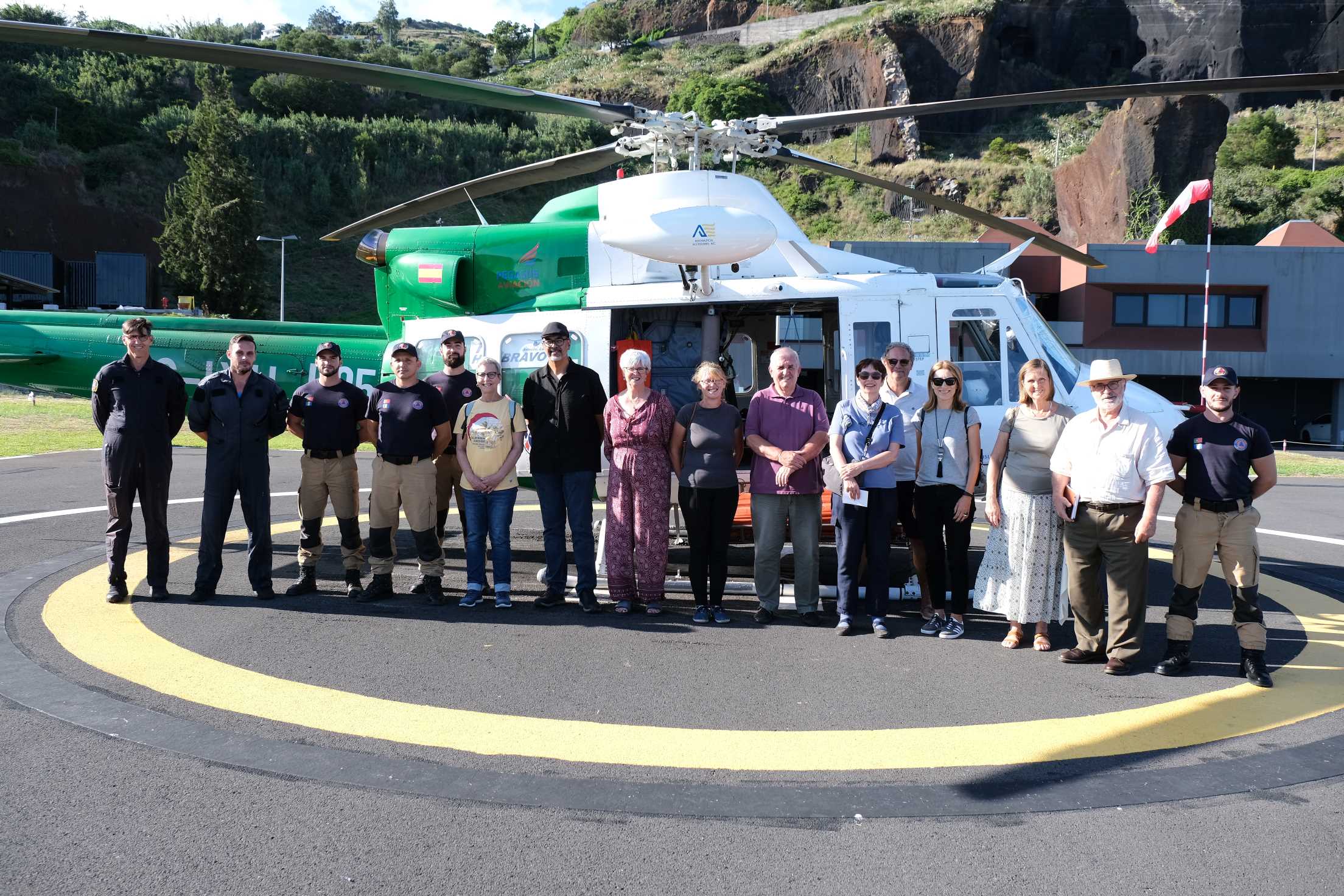
Dr. Quintino gave us a basic presentation, and his colleague André showed us the functionalities in the Crisis Centre Room. Then the pilots and crew presented themselves next to the helicopter for us (we don’t need Tom Cruise here…)
The top points:
The SRPC mission is to prevent the risks inherent in situations of serious accident or catastrophe, as well as resolve the effects resulting from such situations, helping people and protecting property. The SRPC also guides, coordinates and supervises the activities carried out by the fire departments, as well as all civil protection and rescue activities. Information to the public (kids and adults) is also a big part of their duty.
During a flooding for example, they are in charge of the coordination of all services involved, including Police, Red Cross, Forest Police, Sanas (water rescue), and all institutions on land. The Navy, Army and Airforce have a separate operation. However, they work closely together ensuring that during an emergency the chain of command is effective and coordinated.
The island has a special situation due to the old days, when there was no Via Rapida. Several locations have their own firefighters /bombeiros / sapateiros, (there are three levels the Sapadores (highest), regular firemen and the volunteers. It is still necessary to maintain three forces due to the topography and difficulty of the island terrain. They work all under the management of SRPC.
The App
The ProCiv Madeira App can be downloaded from the Google Play Store or Apple App. It provides information on the weather situation and real time information during catastrophes.
The App is being promoted at the airport and the port to tourists. However, as André pointed out, it is not tourists who are the greatest problem for them, the locals are more reckless during excursions as they treat the terrain with over-familiarity and confidence. The App also has a location device allowing for ground team to locate your position or as close as and will work whether there is a signal or not. Therefore, ideal for those walking along the levadas or in the mountains.
The App also has all your information including health problems such as diabetes, allowing for EMIR and the emergency services to know beforehand of any pre-existing health issues.
A further idea was mooted, and that was for charging to use the levadas and having a controlled entry system, ensuring that the levadas are not overused, can be monitored and the money used to carry out running repairs and create barriers. Although some tourists completely disregard them, even if there is a 300 m drop the other side. A photo of a lifetime may be the last photo they ever take…
Forest fires
Forest patrol is done by the respective police, and the helicopter is available from June to November. The forest police are responsible for any fire above 900m above sea level. We had the last big fire in 2016.
Fire prevention in the city
Private homeowners know what to do in order to prevent a fire in and around their house – they are information sheets and articles around – but the Portuguese mentality does not lend itself to prevention actually being done.
Forest fire prevention measures
The forests cannot be cleaned (e.g. with mincing machinery) to prevent new fires as on the mainland because of the geography of the island. Old debris piles up, this cannot be avoided. Controlled fires also cannot be applied well on a mountainous island. Fires cannot be prevented but they will be controlled and extinguished in an effective manner.
Wild Camping
Wild camping is not a problem for the firefighters because in the old forests, the humidity is high, and it is less likely that a tourist can create a wildfire there. The Laurissilva does not burn.
Arson
Arsonists set fires; some of them are even known to the police and population. Proof is very difficult to come by. Many have mental health issues and judges tend toward leniency and let them off with a slap on the wrist. This is frustrating for the Civil Protection and other authorities as catching them in the act, in order to obtain proof is problematical.
Fire towers
The old fire towers have been reactivated and are staffed by the Forest Police, but it is difficult to find people to sit in a tower all day and watch for smoke. An island-wide camera system has been established; it is still in beta phase, but once fully functional, it will detect smoke much more reliably. Currently, the sensors are too sensitive and raise an alarm with every passing car that drives down the mountain – heat from the brakes. However, once the initial bugs are identified and fixed, this will be an invaluable detection aid.
Controlled burning
If farmers have land rubbish, which has to be removed during summer (when lighting a fire is strictly forbidden), the fire brigades will accompany this and make sure nothing goes wrong. Farmers often underestimate the” small” fires they light themselves, they may not be aware that such a fire is still burring underneath when they leave.
The type of trees is also important for fire hazards. The islands endemic species have a low fuel yield and do not burn easily, but can be damaged by pests. Eucalyptus and Mimosa are not endemic, and burn easily, they also spread their seed with the help of fire. Eucalyptus is a “good” tree for wood paper making, but bad for the island’s environment. These species also displace endemic plants, suck up the water around them, creating a barren leaf litter which burns easily.
Landslides, falling trees
These events are unavoidable on this island, we will have to live with the risks. After the Monte tree tragedy, local councils cut down any tree they thought could cause a problem.
Control 24/7
The SRPC has a survey system for hot spots, combined with meteorological data so that they can evaluate the risk conditions in any part of the island at any time. They can see at any time where every fire truck, ambulance and other service cars are so that the response time can be optimised by the SRPC team.
All emergencies are categorised into three different levels. From P3, least important to P1, emergency, and in times when the emergency services are stretched to full capacity the system ensures that those who need help urgently, get it.
The Civil Protection are not impressed with hoax calls as they must treat every call as an emergency. They are not there to give information on the weather, road traffic conditions or report your neighbour for having a BBQ, unless the BBQ is out of control.
When contacting 112 in an emergency your first point of contact will be a PSP (Public Security Police) officer, who will ascertain the situation, and then, if it is not a police matter, forward your call to the Civil Protection. Do not hang up until you are told to do so as sometimes the person you are speaking to is taking notes, checking for information and locating the nearest emergency service team. They need to talk to you, so stay on the line.
They will also speak to you slowly. This is not because they are bored with your call. They have been trained to speak slowly and clearly so that it calms you down and allows you time to think, describe what is happening clearly and your location if you are not on a known road or area. Even a large tree, or an outcrop of rocks if you are in the countryside can give them pointers to your location. Obviously, it is easier in an urban location.
Construction after 2010
The riverbeds were clad out with lots of cement – this was successful. Most of the old riverbeds had to be cemented but not only to avoid loss of water. The rivers’ flow rate was improved so that the water is never too slow to drop sediments on the way. After a storm such as “Oscar” in June, a lot of cleaning has to take place in the rivers so remove boulders, trees and other debris, then the water reposited by such a storm as “Oscar” (more than in 2010) is not a problem for the rivers. So, it seems the money (also from the EU) was well spent. André said that rivers do not need to be pretty, they need to be functional.
Global Warming
The island will get hotter and wetter, and sea levels will rise. The Civil Engineers have to plan accordingly so that the sea water does not back up in the rivers during a storm.
Water supply
We have no waters shortages as yet, but we have more residents and tourists. Many municipalities still have to replace old water pipes to prevent water loss (Rua Bom Jesus: done; Rua Joao de Deus: being done now). Sta. Cruz still has 70% water loss in its pipes. The information to the Public should be better, as the recent destruction of city trees has caused outrage. However, these trees have destroyed the water network, so it was decided that when the pipes were replaced to remove the old ones and plant different trees whose roots are not so vigorous or water hungry.
EMIR Ambulances
We also saw the 4 EMIR rapid response vehicles, which come with a nurse and a doctor, they carry half a hospital in the back. One car is equipped for higher zones, three are used in the cities.
The helicopter
The Chopper has a crew of 8, which includes divers and additional firefighters if needed. They don’t use salt water; they scoop sweet water from eight sweet water lakes (a plane could not do that).
When the helicopter arrives at a fire, it will always circle the spot once or twice and send live images to the dispatch in Cancela so that they can assess what is needed on the ground to fight the fire. (They also have a some very useful drones for the evaluation, with heat indicators and zoom functions.) Then the chopper will set down a team of firefighters. The water (capacity 1200l in the bag, they usually load 1000 l) is not specifically used to extinguish the fire, it is used to douse the spot to lower the heat so that the team down there can work in safety.
The new hospital will have a landing site for the Chopper. At the moment they have to land at the airport and then the victim is transport by ambulance to hospital, which in the case of an emergency is inefficient and time consuming.
The helicopter is also used for search and rescue missions -day time only and has proved to be successful. Only last week two Czech tourists became lost and were airlifted to safety. On another occasion the helicopter crew managed to save a couple of lost tourists, as from the air they were able to identify their location, allowing the rescue teams to find them before darkness.
The helicopter can be changed from firefighting to rescue mode and vice versa in ten minutes.
Both helicopter pilots are highly trained and skilled as Madeira’s topography makes flying difficult, and not only due to fires, but down and up drafts can make flying hazardous.
Although the helicopter and crew have a two-hour flight time, most missions are contained within a one-and-a-half-hour period.
Charging for rescue operations?
Often, an accident sends a rescue large team into danger to rescue a person who has put himself in danger on a Levada. Could/should the state charge for the rescue? There we would have to draw a line after which we can charge at least part of the rescue cost to the person. But André thinks that it is not easy to distinguish what is only “stupid” or really reckless. This could be a topic for further discussion.

Many thanks to the SRPC Team!
Create a free website or blog at WordPress.com.
Entries and Comments feeds.
 Madeira Consorcio